
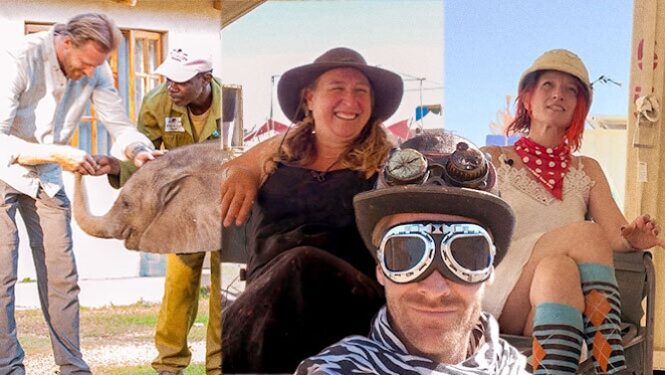
From AfrikaBurn to Black Rock City (BRC) and beyond, people draw inspiration from Burning Man in many different ways, often using the experience as a springboard for ideas and tools that they later apply back home.
Under the stars of the AfrikaBurn Tankwa desert, Bastiaan den Braber reconnected with his love for the African continent, and began to implement an idea that could be a gamechanger for African wildlife conservation. While at BRC, Dara Dotz helped manage a chaotic 3D printing art project that kept going wrong. She would later use the skills she learned on playa to prototype tools that would be rolled out in disaster situations in over 20 countries. Already experimenting with early 3D printing and CNC technologies, Kate Gage drew inspiration from the creative ways Black Rock citizens were applying these tools to build art and solve immediate problems on playa.
Helping build temporary cities was a formative experience for all three. Participating in Burning Man can help shape “changemakers,” people who take positive action out in the world. At the same time, it allows those already working in social impact to experiment and rethink how they work.
Meet three changemakers whose experiences carried outward in unexpected ways. Each show how experimentation through Burning Man can translate into meaningful change — both in their own lives and in their broader communities. Sometimes all it takes is stepping away from the noise of the outside world to reconnect with a sense of purpose.
In Black Rock City and across the Regional Network, many others are involved in inspiring initiatives. If you’re one of them, please get in touch or comment on the article, we’d love to hear your story.
Kate Gage: From Makerspaces to City-scale Systems
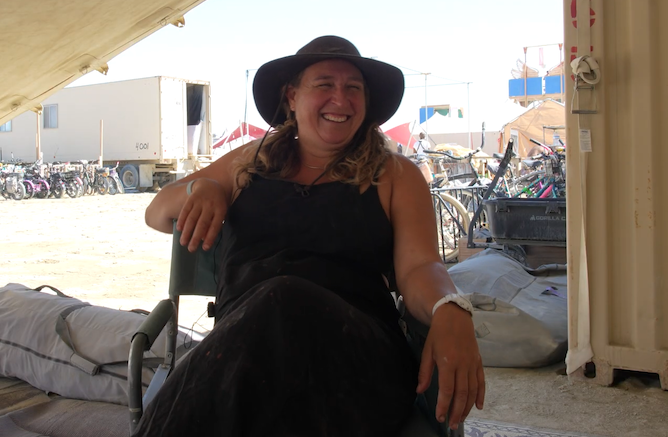
When Kate Gage arrived at Black Rock City in 2017, she had been working to support makerspaces and communities across the United States. She describes the maker movement as being rooted in empowerment. “It’s about giving communities the tools to build solutions to their own problems,” she says. “That really starts with space and access.”
At the time, rapid prototyping technologies such as 3D printing and CNC machines were beginning to lower barriers to entry. On the playa, Kate saw many of those ideas and tools being put into practice. “People were using laser cutters and fabrication tools to build art, to solve problems for their camps, and to support what was needed around them,” she says.
“It’s about giving communities the tools to build solutions to their own problems. That really starts with space and access.” – Kate Gage
Beyond the art and camps, what stood out most to Kate was the less visible work required to keep the city running. “I love the people who build the power, the water, the systems, the roads,” she says. “Some people never see that work, but those skills are brought here and used for the benefit of the whole city.”
She sees Burning Man as a culture where technical skill and creativity come together. People spend months planning, prototyping, and problem solving, learning how to work as teams under pressure and often carrying those experiences back into their lives beyond the playa. “Those skills did not stay on the playa. Many participants carried them home, sometimes starting businesses and even contributing to or building makerspaces in their local communities.”
“At its best, Burning Man is a huge mutual aid project,” she says. “People show up for each other.”
Dara Dotz: From Prototyping on the Playa to Practical Solutions
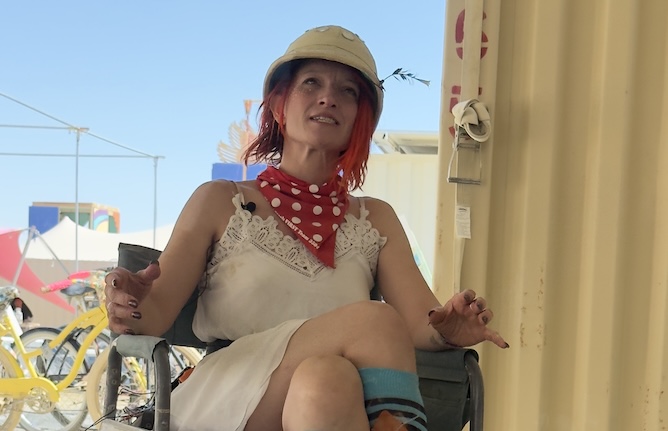
Dara Dotz’s first Burn involved helping build a performance piece that 3D scanned people and printed small statues of them on the playa. Things did not always go smoothly. “People kept stealing our power,” she says. “We had to restart the printers again and again. The statues just kept getting smaller.”
The experience became an intense lesson in leadership and improvisation. Dara learned how to pull teams together, teach people with no technical background, and adapt when systems failed.
Later, a connection from her camp led her to Haiti, where she began working alongside a nurse who had run out of basic medical supplies. Faced with that reality, Dara began to see a new possibility. “I thought, what if we could 3D print medical tools on demand?” she says. “They would come out hot and sterile, ready to use.”
That idea marked a shift from an experimental art project to teaching people how to design and make their own medical equipment. She co-founded Field Ready, an organization focused on manufacturing essential humanitarian supplies locally. The work has since been deployed in more than two dozen countries. “Believe it or not, that all ties back to Burning Man,” she says. “We apply leave no trace. If you can’t get more supplies, you grind the material down and recycle it. You use what you have.”
For Dara, Burning Man creates a particular kind of resilience. “We all become these little MacGyvers,” she says. “You solve complex problems, but no one’s life is at risk. You learn by doing.”
Bastiaan Den Braber: From Idea to Applied Conservation
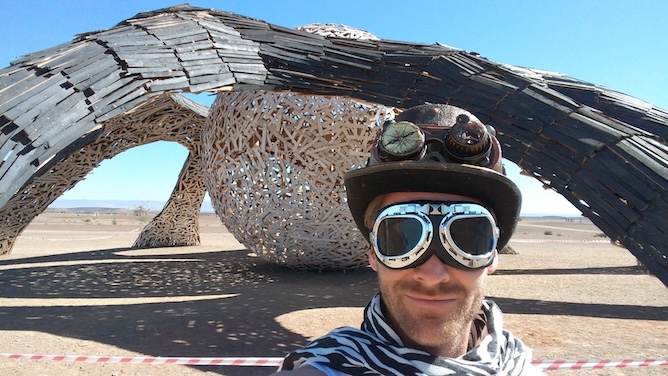
Bastiaan Den Braber’s experience began at AfrikaBurn. With a passion for wildlife conservation, he found himself one night inspired by his connection to nature and the playa finally articulating an idea he had been carrying for years. “That was the moment,” he says. “I realised what my role in this whole ecosystem could be.”
After returning home, he began mapping out what would become Zambezi Zero, an organization focused on conservation in Africa, with the aim of developing scalable intelligence systems to support biodiversity protection.
Through connections made at AfrikaBurn, Bastiaan was introduced to others who would later become collaborators in Zimbabwe. Together, they began applying AI to analyze elephant vocalisations. By combining acoustic data with behavioral research, the team worked to make sense of information that was largely fragmented. “We already know what many of their vocalisations mean,” Bastiaan says. “The challenge was systemizing that knowledge.”
Once trained, the system is designed to scale through the use of low-cost sensors, for potential deployment across Africa’s 8,700 protected areas. “The goal is prevention,” he says. “Intervening before an incident happens.”
The technology is also shared with local communities. Alerts provide practical information, such as where planting conditions may be more favourable and how to respond to environmental change. The same system is being adapted to support agriculture and agroforestry, helping communities respond to shifting weather patterns.
For Bastiaan, participation in Burning Man reinforced the importance of collaboration and practical engagement. “It got my hands dirty,” he says. “The more people experience this kind of community, the better it is for humanity.”
How Participating in Burning Man Brings About Real-world Change
These stories, from Kate seeing maker spaces scale to a city, to Dara prototyping for disaster relief, to Bastiaan applying AI to conservation, describe different kinds of work, but they share a common foundation. Burning Man creates conditions where people practice responsibility with limited resources and shared systems. Some arrive already engaged in work that supports their communities. Others leave with inspiration and new ways of approaching it.
Burning Man does not produce changemakers by design. It offers spaces where skills and relationships are tested. What follows depends on how those experiences are carried out into the world.
Cover image: Photos by Jon Bookout and courtesy of Bastiaan den Braber

Love how this shows growth through chaos, honestly feels like geometry dash meltdown, failing repeatedly but slowly mastering patterns until something meaningful finally clicks.
Report comment
Comments are closed.